



お知らせ記事
10 Best Hotels Near Naoshima Island (Plus What to Do If They’re Full)
Naoshima is a small island, and its hotels are even smaller in number. On an island famous for the Chichu Art Museum, the Benesse House Museum, and Yayoi Kusama’s giant polka-dot pumpkins, there are only a few dozen places to actually sleep — which means that during cherry blossom season, Golden Week, and the Setouchi Triennale, Naoshima’s rooms sell out weeks or even months in advance.
Below is our honest, tiered look at the best places to stay directly on Naoshima Island, followed by what we think is the single most useful section on this page: what to do if every one of them is already booked.
Best Hotels on Naoshima Island
Luxury
Benesse House — Naoshima’s original art hotel, designed by Tadao Ando and opened in 1992. Guests get after-hours access to the Benesse House Museum’s galleries, plus sea-view rooms scattered across four separate wings (Museum, Oval, Park, and Beach). This is the property most people picture when they imagine “sleeping inside a museum.” Rooms start from roughly $250+/night, and the Oval wing (reached by monorail) regularly sells out first.
Naoshima Ryokan Roka — A contemporary luxury ryokan that opened in 2019, built around private open-air baths and a curated art collection of its own. It’s the top choice for travelers who want a traditional Japanese stay with a five-star, art-forward twist. Expect rates well north of $1,000/night in peak season.
sana mane — A beachfront glamping village of domed tents, for travelers who want the art-island experience with a resort-camping feel rather than a conventional hotel room.
Mid-Range
My Lodge Naoshima — Bright, modern rooms a short walk from Miyanoura Port, with a Mediterranean-leaning restaurant on site. A reliable, comfortable base if you’re arriving and departing by the main ferry terminal.
Hotel Wright Style — Scandinavian-minimalist rooms between Honmura village and the museum cluster, some with kitchenettes for longer stays. Good for travelers who want to be close to the Art House Project in Honmura rather than Miyanoura.
Sparky’s House — Container-style rooms with a kitchenette and balcony; a slightly quirkier, self-catering option in the mid-range bracket.
Budget
Bamboo Village Guesthouse — A traditional Japanese house on a forested hillside above Honmura, with dorm and private rooms, shared bathrooms, and a communal kitchen. One of the most consistently recommended budget options on the island.
Yado Seven Beach — Simple Japanese-style futon rooms near the coast, at some of the most affordable rates on Naoshima.
Naoshima Kowloon — A colorful, sociable hostel — a good pick for solo travelers who want to meet other people passing through the island.
Tsumuya — A whole-house rental with a retro, lived-in feel, useful for families or small groups who want a private space rather than a hotel room.
What if Naoshima hotels are fully booked?
This is the part most “best hotels in Naoshima” lists skip, and it’s the part that actually matters if you’re booking less than a month out. Naoshima has a genuinely small number of beds — by some counts, fewer rooms than a single mid-size business hotel on the mainland. Once Benesse House, Roka, and the handful of guesthouses above are full, they’re full. There’s no overflow inventory on the island itself.
The practical answer is to base yourself on the mainland and take the ferry over for the day (or for several days in a row). You have two options for that: Uno, in Tamano City, Okayama Prefecture, or Takamatsu, in Kagawa Prefecture. Both have working ferry ports to Naoshima. They are not equally convenient.
Uno vs. Takamatsu: which port town should you choose?
This is a question of ferry time, and the gap is bigger than most guides let on.
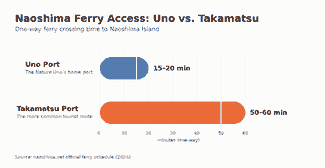
- Uno Port → Naoshima (Miyanoura Port): approximately 15–20 minutes by ferry
- Takamatsu Port → Naoshima (Miyanoura Port): approximately 50–60 minutes by ferry
Takamatsu is the more famous gateway — it’s a bigger city, with an airport and Shinkansen-adjacent rail access, so most guidebooks default to recommending it. But if your priority is spending less time on a boat and more time at the museums, Uno is objectively the faster crossing, at roughly a third of the travel time. Uno also has direct JR rail access (Uno Line) and is a much smaller, quieter town to stay in overnight — no crowds, no big-city detour, just a short walk or taxi from the station to your hotel and a short ferry ride the next morning.
Where to stay in Uno
If the ferry-time math above has you leaning toward Uno, we’ve written a full, separate guide to where to stay there — including a quiet, fully-renovated kominka (traditional Japanese farmhouse) built specifically around slowing down after a day of art-viewing.
→ Read our full guide: Where to Stay in Uno Before Visiting Naoshima
A brief note on Takamatsu
If you’re combining Naoshima with other Setouchi islands (Shodoshima, Teshima) or need airport/Shinkansen access, Takamatsu still makes sense as a base — hotels like JR Clement Inn Takamatsu and Dormy Inn Takamatsu are well-reviewed, centrally located options near Takamatsu Station and the ferry terminal. Just budget the extra 30–40 minutes each way on the water.
FAQ
How far in advance should I book a Naoshima hotel?
For Benesse House or Roka, 2–3 months ahead is safest, especially for spring, autumn, and Setouchi Triennale years. For guesthouses, 3–4 weeks is usually enough outside of peak weekends.
Is it better to stay on Naoshima or on the mainland?
Staying on Naoshima itself means no ferry schedule to work around and evening access to the island’s quieter side. Staying in Uno means more room availability, lower rates, and a genuinely fast (15–20 minute) ferry connection back the next morning.
Can I day-trip Naoshima from Uno?
Yes — it’s the shortest ferry crossing to the island from any mainland port, which makes Uno the easiest base for a day trip or a multi-day art-hopping itinerary.
